Making one check feel finished.
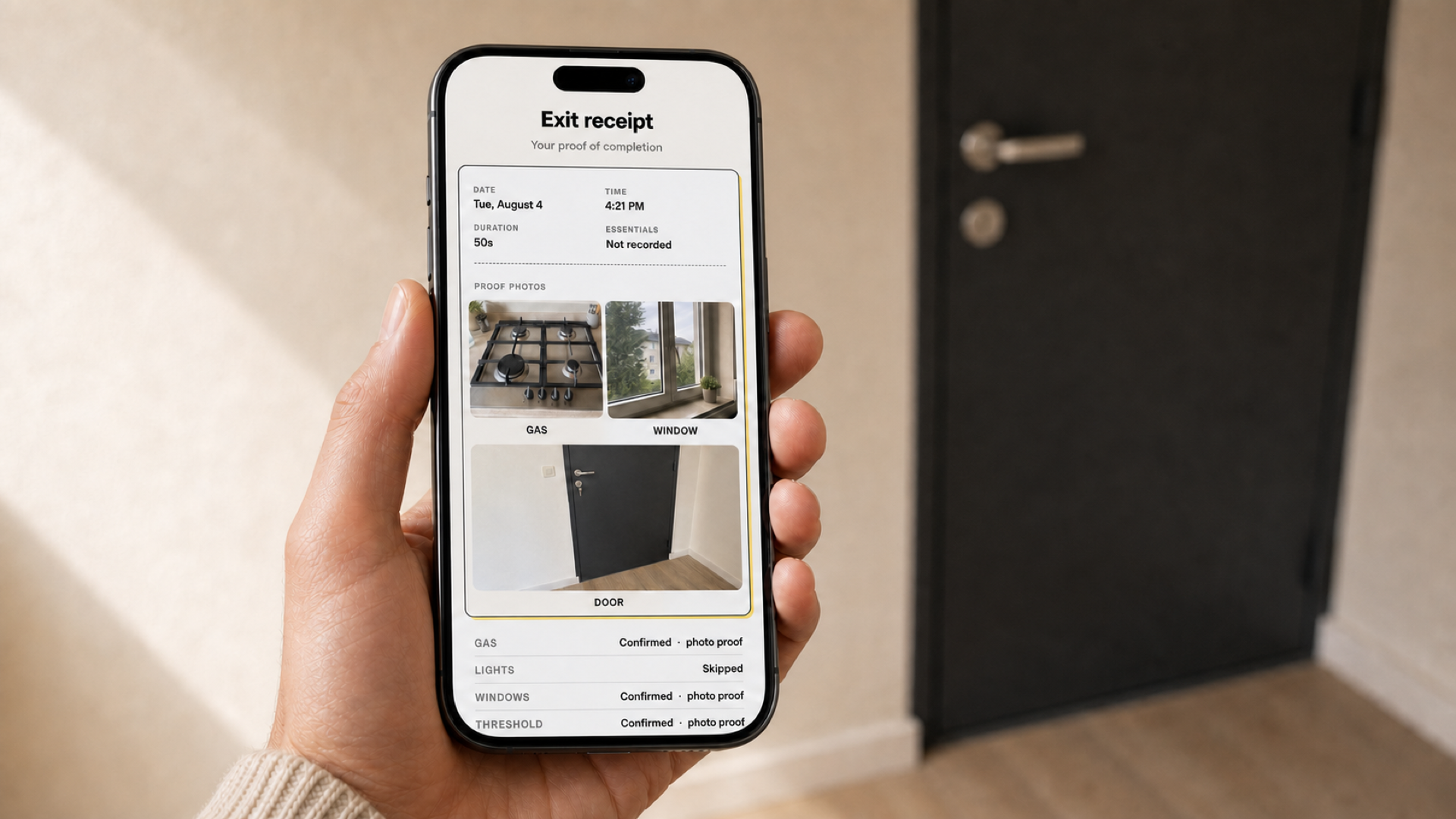
Anchor is a tactile exit ritual for the moment after you leave home and wonder, “Did I turn it off?” It guides a short sequence of intentional checks, then keeps the evidence in one private, timestamped receipt.
Working mobile web app
The problem is not always forgetting. It is not trusting the memory.
A routine physical check can happen on autopilot: the stove is off, the window is closed, the door is locked. Later, under stress, the action may be difficult to recall clearly, even when it happened.
I reframed the opportunity from "help people remember more tasks" to "help one completed check receive enough attention to be remembered and revisited."
How might a digital ritual support attention and closure without pretending to replace the real-world check?
A passive tick is easy to complete and easy to forget. Anchor gives every part of the flow a distinct job.
A deliberate gesture slows the moment just enough to bring the physical check into focus.
Optional photo proof records the physical state when the user wants stronger evidence.
A timestamped Exit Receipt gathers the ritual into one end state instead of inviting another loop.
The default ritual covers common leaving-the-house concerns. Steps can be removed or customized, and every step can be confirmed by interaction, by photo, or skipped.
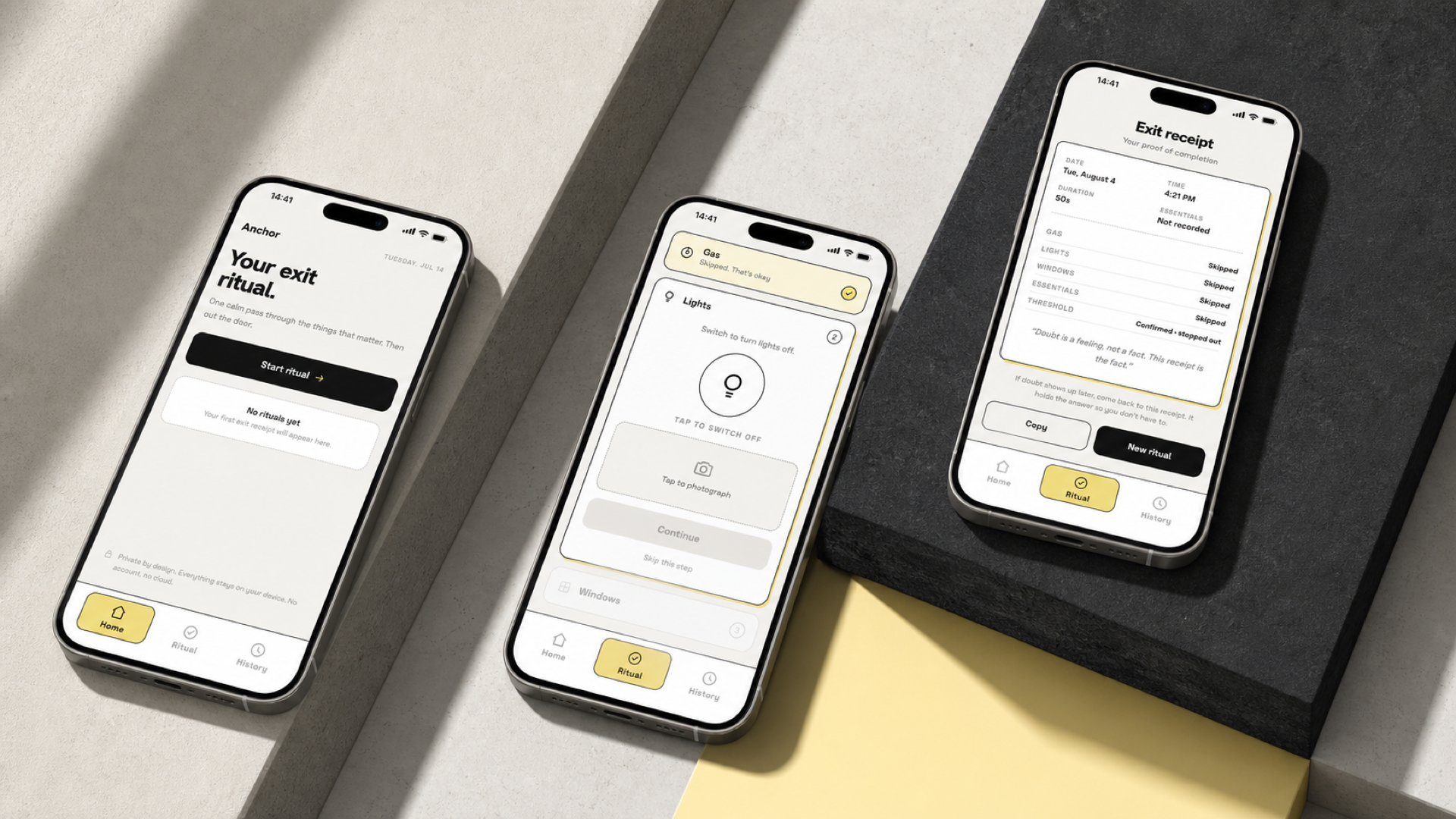
Home, active ritual and receipt, the product is structured around a clear beginning and end.
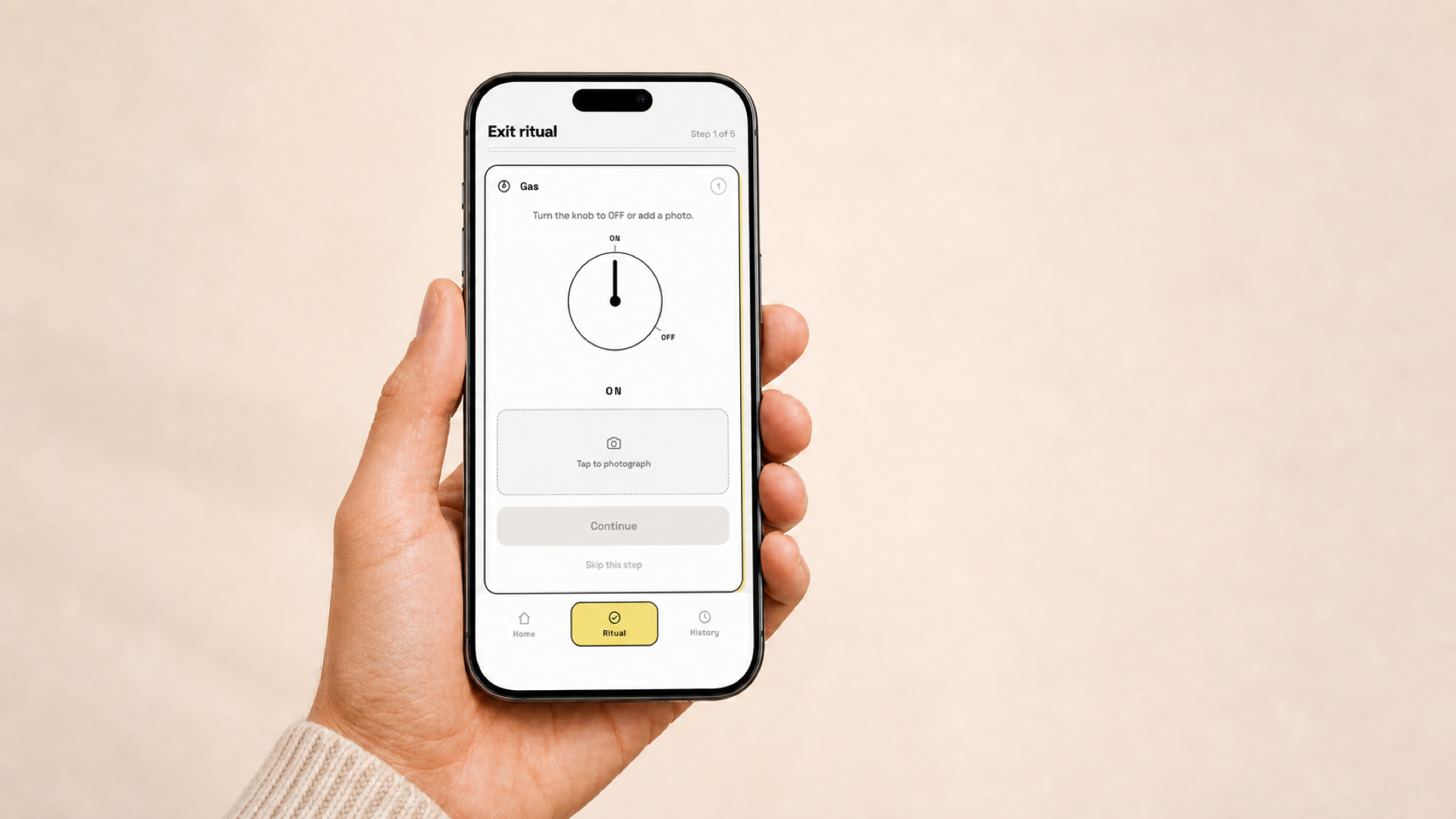
Rotate a digital knob after checking the real stove, or add a photo.
Rotate · photograph · skipA single press confirms the room check without extra decisions.
Tap · photograph · skipDrag the latch to its end-stop to create a distinct confirmation.
Slide · photograph · skipConfirm an editable list such as keys, wallet and phone.
Check items · customizeFinish the sequence and turn the completed ritual into a receipt.
Confirm · receive receiptThe first interaction direction was visually engaging, but it blurred the difference between the real action and its digital representation.
Close the real window, then close a digital window. Later, the user might remember the interface more clearly than the physical action.
The physical check stays primary. The gesture marks attention, an optional photo holds evidence, and the receipt creates closure.
The gestures are not simulations of household devices. They are intentional markers: movement, resistance, a visible end-stop and a short haptic response make confirmation feel different from a passive tap.
Drag the handle to the far edge. Use Enter or Space for keyboard confirmation.


One object to return to instead of restarting the ritual.
The Exit Receipt combines time, duration, confirmation method and any photos the user chose to take. Receipt history stays in the browser on the user's device.
The prototype is embedded below. For the intended experience, including camera input and haptics, open it on a phone.
Customize the sequence, test the gesture confirmations, add optional photos and generate an Exit Receipt.

I used AI as a pair-programming and debugging partner to shorten the distance between an interaction idea and something I could feel on a phone.
I retained responsibility for the framing, product model, interaction direction, critique, ethical boundaries and final decisions. AI accelerated execution; it did not supply validation.
Define the human tension and the boundary of what the product should claim.
Translate intended behavior, state and feedback into a working interaction.
Use the prototype on a phone to judge timing, gesture weight and end states.
Change what fails at the model level, then rebuild and test the interaction again.
Anchor is an interaction hypothesis, not a mental-health treatment. The prototype has not been clinically validated, and the case study does not claim that it reduces anxiety. Its design intent is narrower: support one deliberate check, preserve optional evidence and provide an explicit ending.
I adapted the working build for a Raspberry Pi kiosk and presented it as an interactive exhibit.
Reframing the need from remembering tasks to trusting a completed check produced a more focused product model.
Gesture weight, feedback and end states can carry emotional intent that static screens cannot communicate.
I carried one idea through product definition, interface behavior, a working build and a physical exhibition format.