Product DesignE-LearningAI Mentor

Elevio

Learning doesn't fail because people stop caring, it fails when support disappears.

Elevio is an AI-powered e-learning platform that reduces learner drop-off by placing a mentor right inside the learning journey, real-time, personalized help through an interactive AI assistant.
Role

UI/UX designer

Timeline

10 to 11 weeks

Contribution

Research, UX, visual design and prototyping

Mentor

Ehsan Ezzati

Elevio, a learner surrounded by scattered books

Four surfaces, one mentor

Pick a screen, the mentor stays with the learner across all of them.

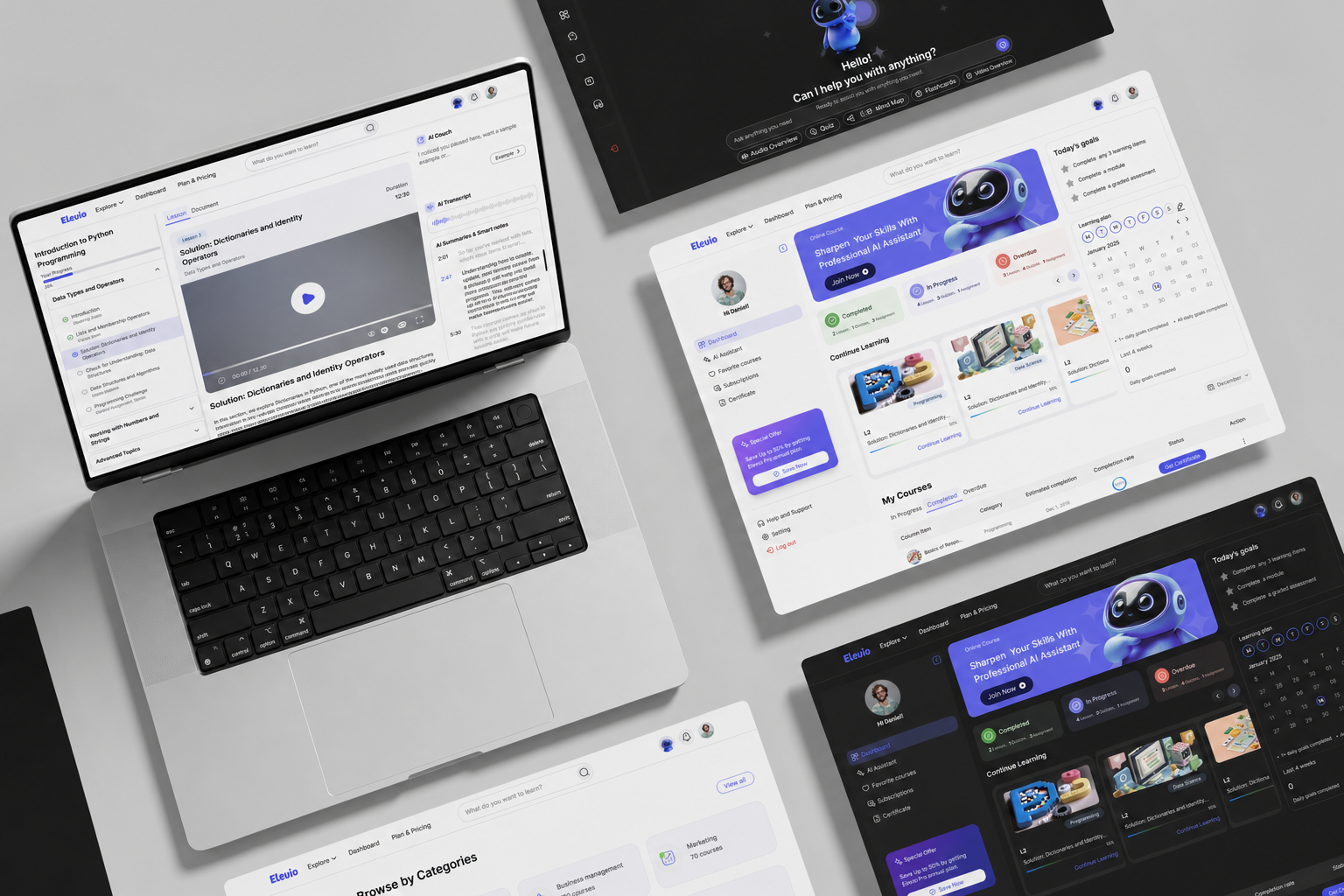
Learning Dashboard AI Mentor Lesson Discover
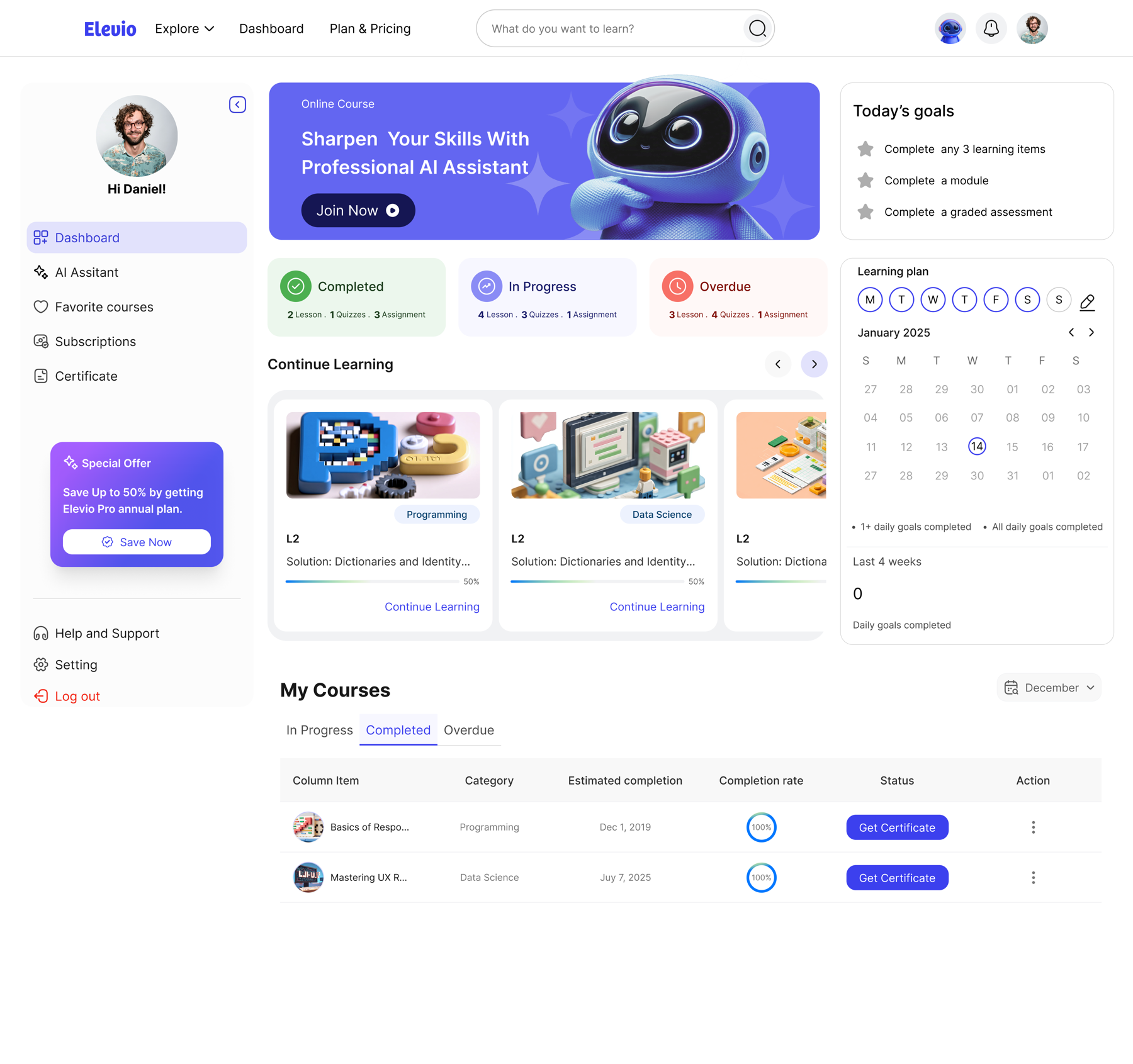
Learning Dashboard, today's goals, continue-learning, and progress, with the AI mentor one tap away.

Most online platforms focus on delivering content, not supporting the person learning it. Learners feel lost, unmotivated, and unsupported, and quietly drop off. Elevio embeds an AI mentor that guides users before, during, and after each course: choosing the right one, understanding hard concepts, tracking progress, and staying motivated, like having a human mentor, at the scale of software.

The what

A SaaS learning platform with expert-led courses supported by an AI mentor.

The why

Learners abandon courses from lack of guidance, delayed feedback, and low motivation.

The product decision

Keep one context-aware mentor present from course discovery to the lesson itself, instead of sending learners to a separate help area.

UX research

Understanding why motivated learners still stop

I used generative research to move beyond the broad label of “low engagement.” The aim was to find where uncertainty enters the learning journey, what people do when support is unavailable, and which forms of guidance feel useful rather than intrusive.

QUESTION 01

What makes choosing a course feel difficult or risky?

QUESTION 02

What happens when a learner becomes stuck mid-lesson?

QUESTION 03

What helps someone return after losing momentum?

Desk research

Learning behaviour, motivation, and course-completion patterns.

Competitive review

Discovery, lesson support, progress, and feedback patterns.

Learner interviews

Semi-structured conversations about choosing, struggling, and returning.

Synthesis

Recurring signals grouped into needs, breakdowns, and opportunities.

Research scope: Generative research shaped the problem definition and product direction. It was not a large-scale measure of completion impact.

Competitive patterns

Strong content, fragmented support

I reviewed the learning journey rather than comparing feature counts. Existing patterns often handled individual moments well, but rarely connected course choice, in-lesson help, and return-session guidance.

Discovery

Choice is abundant

Filters support browsing, but learners still judge relevance, difficulty, and fit alone.

Lessons

Content is structured

Modules create order, but confusion can send learners to another tab or source.

Progress

Completion is visible

Percentages record what happened without always clarifying the next useful action.

Support

Help is separated

Forums, FAQs, and generic chat often lack the context of the current lesson.

Research synthesis

Four insights that changed the product direction

The research shifted Elevio from an e-learning platform with AI toward a continuous guidance system.

Insight 01 · Choice

More options do not create more confidence.

Learners evaluate relevance, difficulty, time, and expected outcome at once. A large catalogue can increase uncertainty.

Need
A reasoned recommendation, not only filters.
Decision
Use goals and context to narrow the path.
Insight 02 · Friction

One confusing moment can break the session.

When clarification requires searching elsewhere, learners lose both lesson context and momentum.

Need
Immediate help that understands the lesson.
Decision
Place the mentor directly beside the content.
Insight 03 · Return

Progress without direction is only a record.

A percentage can show completion while leaving the learner unsure what to resume or prioritize.

Need
A fast answer to “where was I?”
Decision
Prioritize today’s goal and continue-learning.
Insight 04 · Trust

Support must stay learner-controlled.

Help feels useful when available and specific, but intrusive when it interrupts or takes over the task.

Need
Assistance on demand, with a clear boundary.
Decision
Keep the mentor present but secondary.
The problem

Access isn't the issue, finishing is.

I framed the experience around three moments that can break a self-directed learning journey.

BEFORE THE COURSE

Choosing without context

A large catalogue creates more comparison, but not necessarily a clearer next step.

DURING A LESSON

Getting stuck alone

A difficult concept becomes an exit point when useful help lives outside the lesson.

BETWEEN SESSIONS

Losing the thread

Returning learners need to know what changed, where they stopped, and what to do next.

The opportunity was not another chatbot. It was continuity across the learning journey.
How the experience works

One mentor, designed around four learner moments

Each surface answers a different question, while the mentor carries the learner's context forward.

DISCOVER

What should I learn?

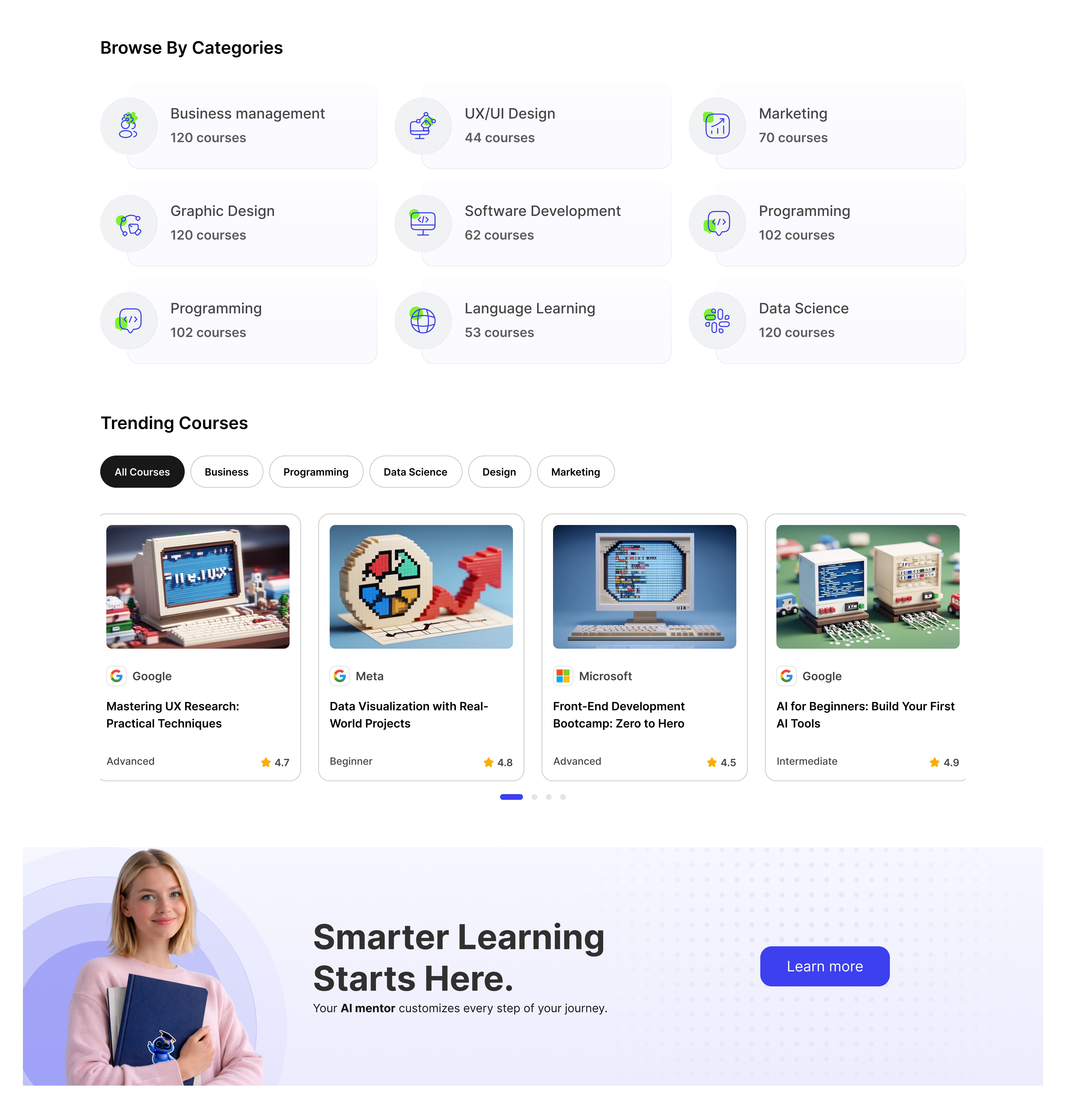
Course cards make level and direction easier to scan before committing.

PLAN

What matters today?

The dashboard turns progress into a short, visible next action.

LEARN

Can you explain this?

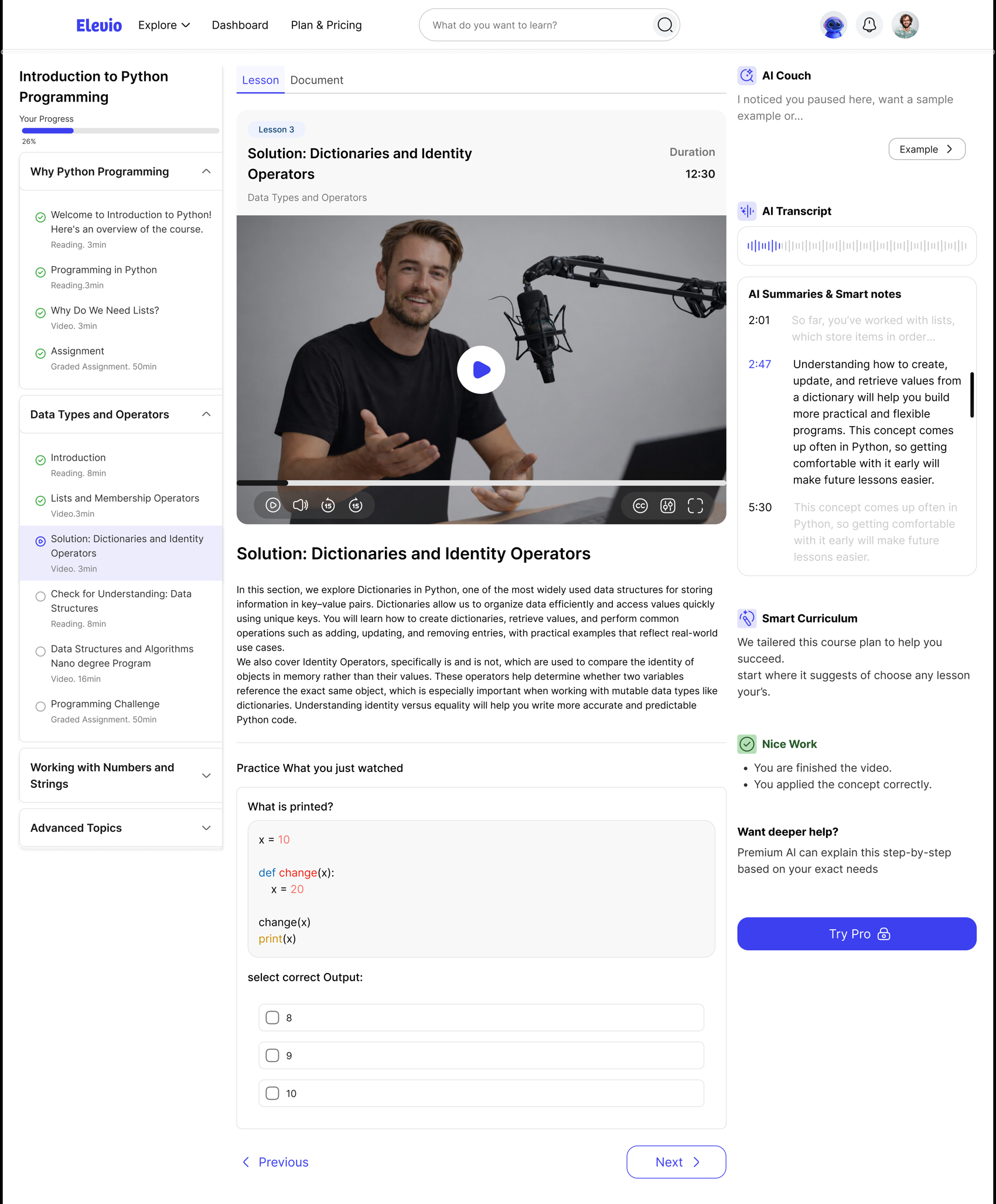
Context-aware help stays beside the lesson, so asking does not interrupt learning.

RETURN

Where do I continue?

Progress, notes, and recommendations rebuild context after time away.

The product bet

  • Support is more useful when it appears inside the task
  • A clear next step is more motivating than a generic progress score

Interaction guardrails

  • The mentor is available without competing with course content
  • Answers use the current lesson and progress as context

What I would validate

  • Whether learners reach useful help faster
  • Whether more sessions end with a clear next action

A mentor as a sidekick, always there, never in the way

Elevio 3D AI mentor standing on a stack of books
Graduation cap

AI mentor capabilities

  • Instant, context-aware Q&A tied to the lesson
  • Explains concepts in simpler ways
  • Summarizes lessons and creates smart notes
  • Generates practice questions
  • Recommends next steps based on progress

UX principles

  • Mentor as sidekick, available, never distracting
  • Help in context, support lives inside the learning screen
  • Clear structure, users always know where they are
  • Motivation by design, progress tracking + encouraging feedback

Why a 3D character?

To create presence and emotional engagement, making the mentor feel like a companion, not a generic chatbot.

From screens to experience

Click any screen to zoom.

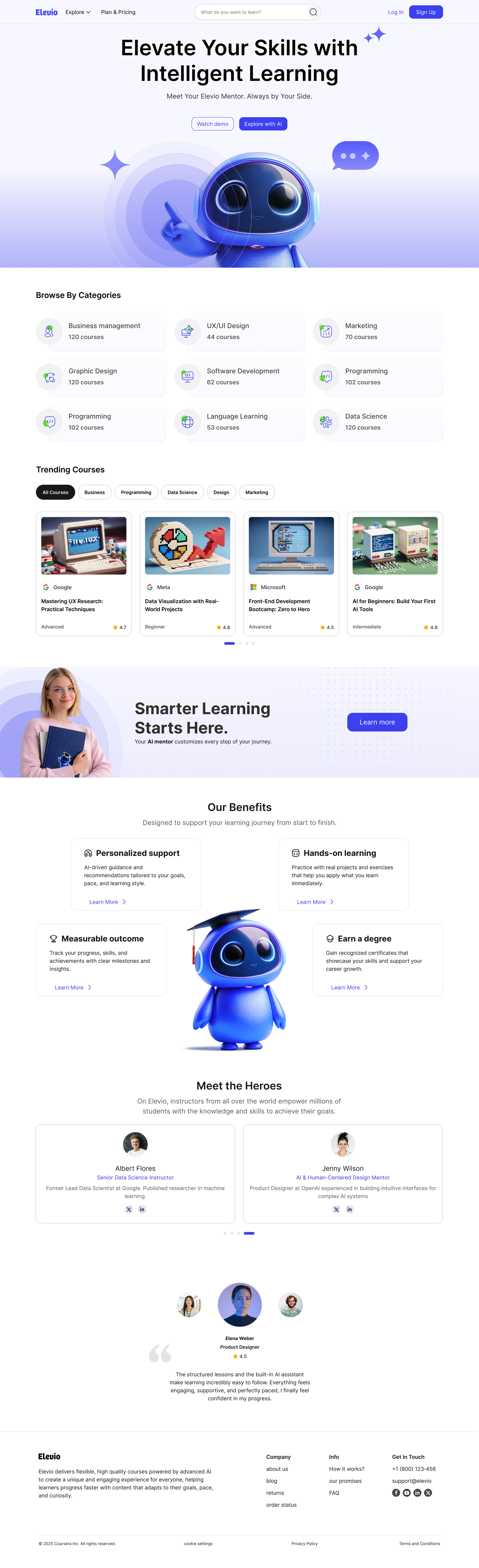
Landing
Landing, "Elevate your skills with intelligent learning."
Dashboard
Learning dashboard, goals, continue-learning and progress in one place.
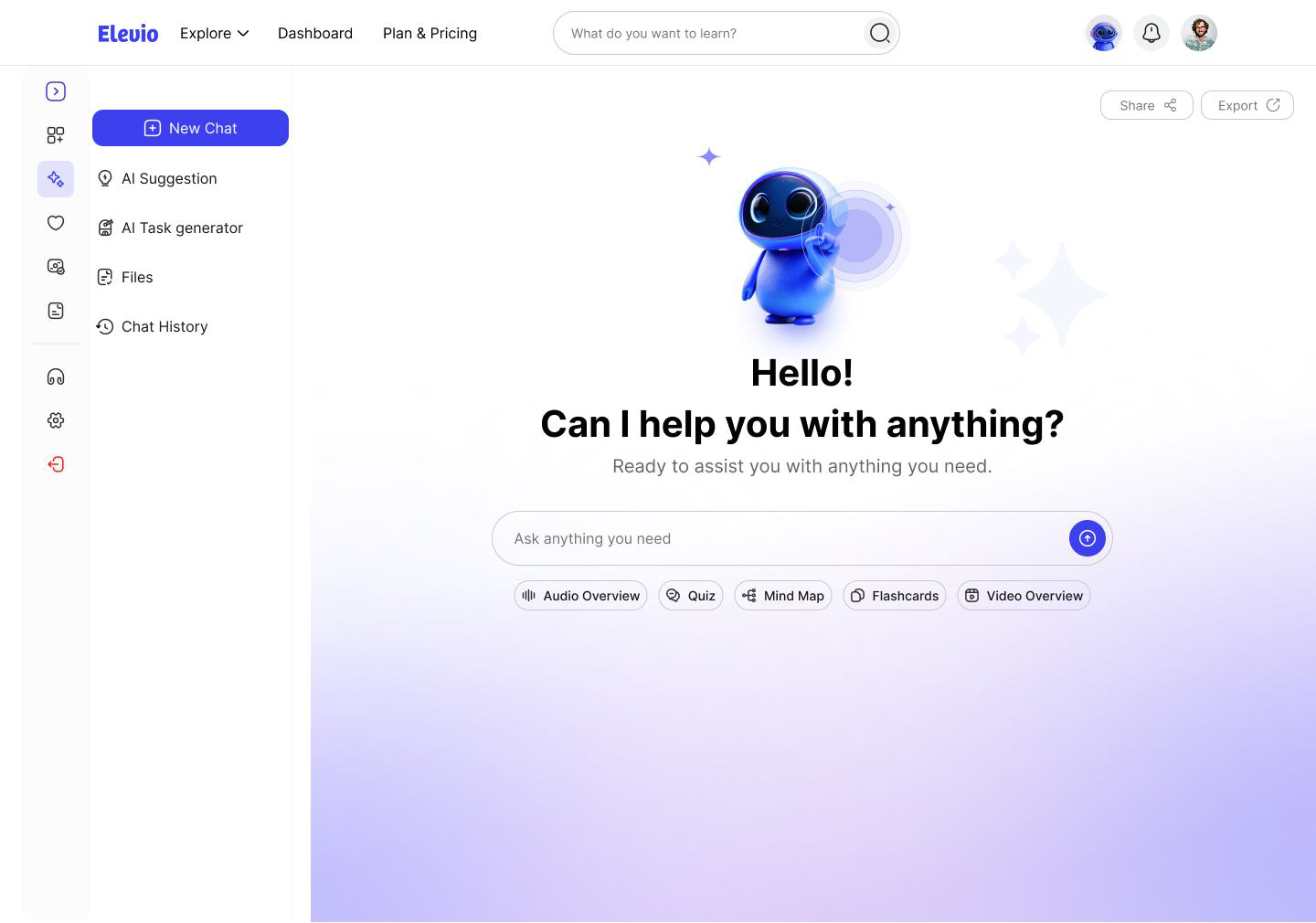
AI Mentor
AI mentor, "Hello! Can I help you with anything?"
Lesson
Lesson, learn with an always-available "ask while learning" panel.
Discover
Discover, clear course cards and categories.
Login
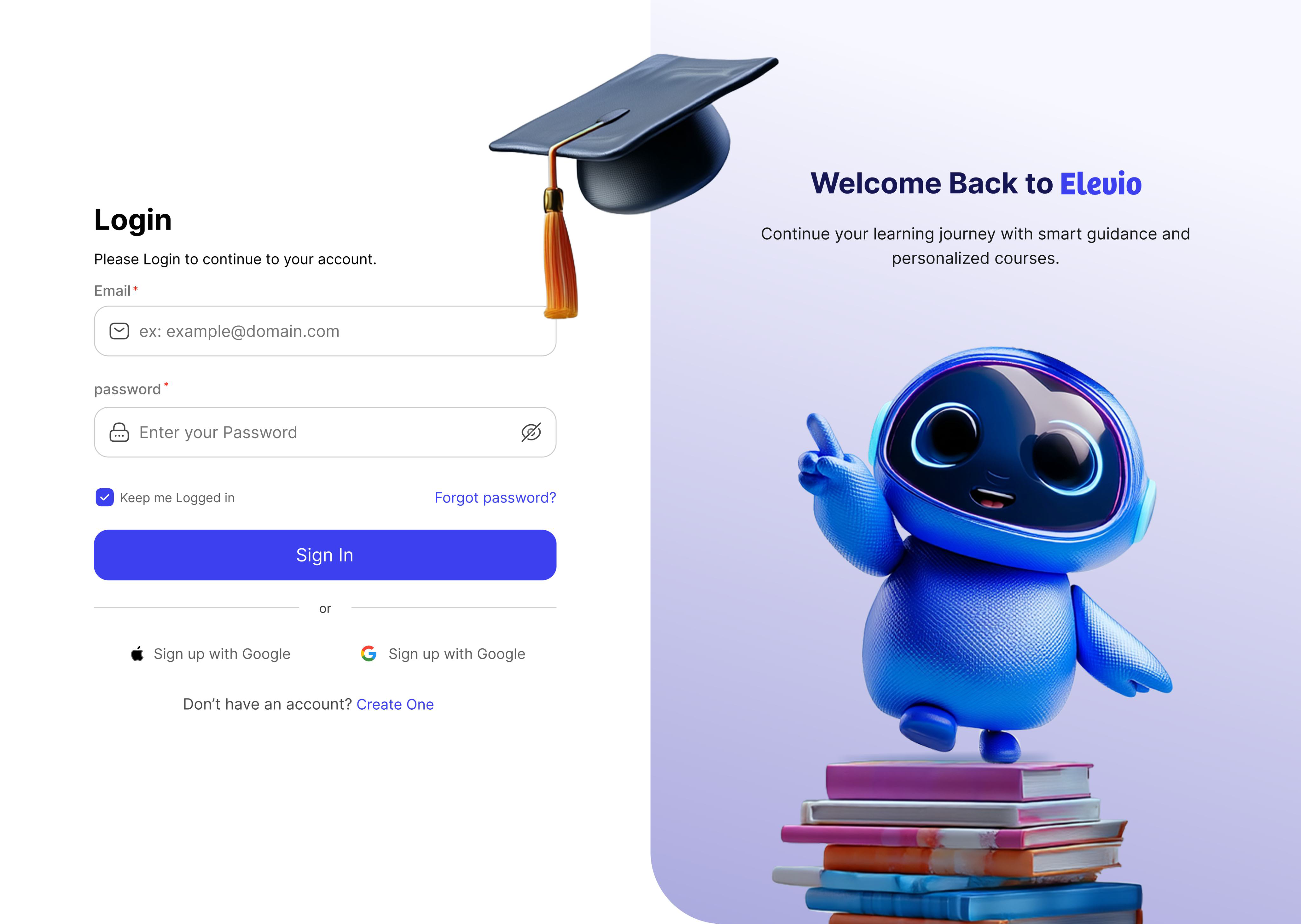
Welcome back, a warm, mentor-led re-entry.

What I learned

Designing learning platforms isn't just about organizing content, it's about reducing uncertainty and building trust.
Mentorship is a UX problem, not just a feature. Users need guidance, reassurance, and clarity throughout their journey, especially in self-paced learning.
Designing the AI mentor meant balancing functionality with personality, supportive and human, without becoming distracting.
If I continued, I'd further test the mentor's tone, personalization level, and long-term impact on motivation and completion.
Next project Anchor
✕ close